
An Easter Blessing.

Greetings Neighbors and Strangers,
I’m sending this out a day early, in part because this is Easter morning. Dawn waits, pregnant and black beyond the pane. A wild wind blows from the southeast, strong enough to call the living to wakeful attention. Stay awake, friends, stay awake. On Friday I got to meet and share a meal with a remarkable West African man named Mohammed. He blessed this place with his story, and I will endeavor to pass that blessing along to you. May that these words serve as medicine for a divided, disheartened and displaced time.
Occasionally, and perhaps against my better judgement, I take a look at the comments feed on the short film with my face on its title page called Radical Neighboring. The opening line of one comment in particular caught my attention: “I’m probably going to get a lot of flak for writing this, but I’m going to do it anyway.” Are everyone’s ears pointed in this direction yet? “I identify with conservative, or right-wing politics,” the commenter continued, “and I have to say that this is the kind of liberal activism I can actually get behind.”
My first feeling was the sort of defensiveness that comes from being assigned a social category against your will. Once my indignation cooled, however, I did a mental scan through the folks pictured in the film and had to admit that most of them probably voted blue in recent elections.
Is it sacrilegious to drop out of the political binary all together? To suggest that neighboring offers a real alternative to the binary-oppositional industrial/market/state/charity/consumer/citizen complex?
I call this weekly note the Peasantry School Newsletter for a lot of real reasons. As such, I mostly steer clear of global politics. You can find that tug of war everywhere else. But a convergence of conversations this week has me tip-toeing along the edge of the socio-political crater that Ivan Illich illuminates in his 1977 book Toward a History of Needs, which I began reading a few days ago upon Samuel Ewell’s suggestion.
Illich was born in 1926. When he was learning to speak, ‘need’ was mostly used as a verb. Popularizing the noun and adjective forms of that word, as in “I have needs” and “Who is going to help the needy?” set the stage, according to Illich, for the modernization of poverty—a progressive condition emerging from the multiplication of needs. Formal, compulsory schooling “qualified graduates to climb to ever more rarified heights and implant and cultivate there ever newer strains of hybridized needs.”
How will all of those new and novel human needs get met? By ensuring ample paid employment within a growth-reliant industrial economy so that everyone who works hard has sufficient dollars to purchase dental insurance, annual vacations and smartphones? Or through a state-sponsored model of distributive need gratification? To my ear, the commenter on the Radical Neighboring film was stretching for words to say that neighboring is stubbornly, and persistently non-partisan. Here’s more from Illich:
Used as a noun, “need” is the individual offprint of a professional pattern; it is the plastic-foam replica of the mold in which professionals cast their staple; it is the advertised shape of the brood cells out of which consumers are produced. To be ignorant or unconvinced of one’s own needs has become the unforgivable antisocial act. The good citizen is one who imputes standardized needs to himself with such conviction that he drowns out any desire for alternatives, much less for the renunciation of needs.
Illich’s writing can be a bit impenetrable. I’ll attempt to translate here. In the presence of food that is a gift, I get to witness the voluntary renunciation of the personal needs mandate again and again. Hundreds of times per year, I hear someone say aloud, “Surely someone else needs this more than I do.” The next day, when I drop a quart of soup off as a gift in the part of town where the “needy” live, I get to hear the same thing. So, what’s going on here? Who actually needs this food the most? Can’t we find a professional with a well-researched answer to that question so we can finally get to the bottom of this problem once and for all? Wouldn’t it be a whole lot easier to get back to thinking about our own needs?
When Illich suggests that renunciation of the consumer mandate to pursue personal need gratification is antisocial, he is pointing to the difference between a society and a culture. If societies enshrine the pursuit of personal liberation from Earthly limits, we could say that human culture emerges around a table where the total local harvest, and the people with whom it must be shared, remain in view. In such a local life-world, “Surely someone needs this more than I do” isn’t an abstract thought experiment.
Other questions might begin to make more sense: Who is still hungry? Who is in pain? Who has strength in their hands? Who will help me hoe the corn patch so that there’s something to eat next winter? Who will stay back and sing to the children? Who will repair the roof on granny Margaret’s house that was damaged by last night’s wind storm? How did we become so lucky to be surrounded by neighbors who relentlessly insist on keeping us in mind?
Some of those neighbors are humans. Many, many others are nonhumans. Illich suggests that, “beyond a certain threshold, the multiplication of commodities induces impotence, the incapacity to grow food, to sing or to build.” The Peasantry School gathers in the crater of that commodity-induced culture loss.
As I was immersing myself in Illich’s admittedly heady thinking last week, I had an opportunity to see some of these dynamics play out in real time. When I arrived at the bus station on Friday, the friend I was fetching asked me if it would be alright if Mohammed joined us at the Farm for dinner, as his south-bound bus wouldn’t arrive for three hours. I could immediately feel the pull of my own perceived need for an early bedtime, given the full schedule of Farm events over the coming weekend. I silently acknowledged my internal resistance to the spontaneous request for hospitality, let it pass, extended my hand in greeting, then opened the back door of the car.
As we drove toward the Farm, I learned a bit more about my surprise dinner guest. After making his way across the Mexican border into Texas three years ago, Mohammed has been traveling the states in search of paying work so that he can wire money back to his wife and two children. He left home a few months after his daughter was born. The smartphone in his pocket allows him to father from the road.
His first question for me was, “Would you hire me to work on your Farm?” Thus began a thought-provoking translation of this project in the presence of the world as it is.
Mohammed grew up in a post-colonial West African city, where human needs are informed by the Western example and satisfied through dollar procurement. That’s why he set out on a harrowing journey of illegal border crossings and under-the-table cash payment deals. During dinner, he actually got a call from a friend who knows someone with a gig doing electrical work on the East Coast. Suddenly, he wasn’t headed back to California.
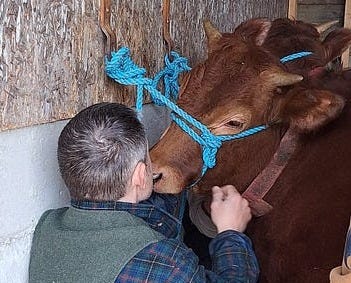
When he saw the herd of well-grown cattle in the field above the house, he asked me, “Why don’t you sell some of them so you can get some more money?”
I tried to explain the way the Farm was given as a gift and now every bite of food rising from this land will be offered as a gift to anyone who is hungry for any reason. I watched the story wash over his face, pass through the medium of his Muslim practice, and then emerge in words: “Oh, man, this place is a blessing. You are living from blessings.” His desire to contribute to the flow of blessings meant I couldn’t get him to sit at the table long enough to have a second bowl of soup. I don’t normally allow dinner guests to help wash the dishes, but Mohammed was persistent. I set him up to wash while I worked by his side rinsing and arranging the bowls on the drying rack. I don’t have running water at the house, so my dishwashing arrangement is particular.
At some point he paused to take a call, speaking in animated sentences I couldn’t understand. After he hung up, he said, “That was my mother. She was worried about me, but I described to her where I am right now. She couldn’t believe it.”
Telling you this story runs the risk of positioning me as some sort of savior. But that’s not what I heard in Mohammed’s voice. He saw through my extended hand, right back to the land and, by extension, to God as the giver of blessings. We humans get to do our part by passing those blessings along as quickly and gratefully as we can manage. As we stood in the driveway to bid our goodbyes, Mohammed said to me, “I will be asking God for you to receive continued blessings.”
“I will pray the same for you, my friend,” I replied. For your homecoming and for mine.
From here at the bottom of the crater of post-colonial culture loss, I wish you and yours a blessed Easter.
With love,
Adam
Thank you Adam for the sorrow and joy inducing words, and more important, actions you live by. How wonderfully disturbing your newsletters are, and have been. Many, many Blessings upon your Communal Table on this of many Easter mournings! No, it’s not a typo.
This is a story full of respect for ancient practices, hope for the future and practical examples for the present. It contracts time (and space) and faces us with the reality of living in today’s world. Someone once asked "Who is my neighbour?" The answer was not primarily the person next door, but the (needy) person you meet as you journey through life.
Thank you, Adam, for retelling this story this day…