
Gratitude Pooling

A few weeks back, I introduced the remarkable Eleanor Robins, who has been lending her ears and eyes to the book manuscript. If you missed that intro, you can it here:
Retiring Possessive Pronouns

Before I get into this week’s update on the book, I’d like to let you know that the project has a number of patron saints, some of whom are still alive. One in particular, Dougald Hine, had a hand in conn…
Forty-four of you have chipped in to nearly cover her $4000 stipend request, with just $350 left to go. Might you consider finishing up that gift-gathering effort by clicking the button below?
Greetings Neighbors and Strangers,
Heavy rain washes gullies in the Farm drive, pools in a cow’s hoofprint, soaks the roots of a thirsty corn plant. Pasture grasses lay down, exhausted by the sheer weight of themselves. Lettuce spills from garden beds into wash bins and plastic spinners, and then into salad bowls up and down the road. Hermit thrush chants from sunup to sundown on Summer Solstice; the day’s long arms wrap around us all, neighbors here on this green patch of Earth.
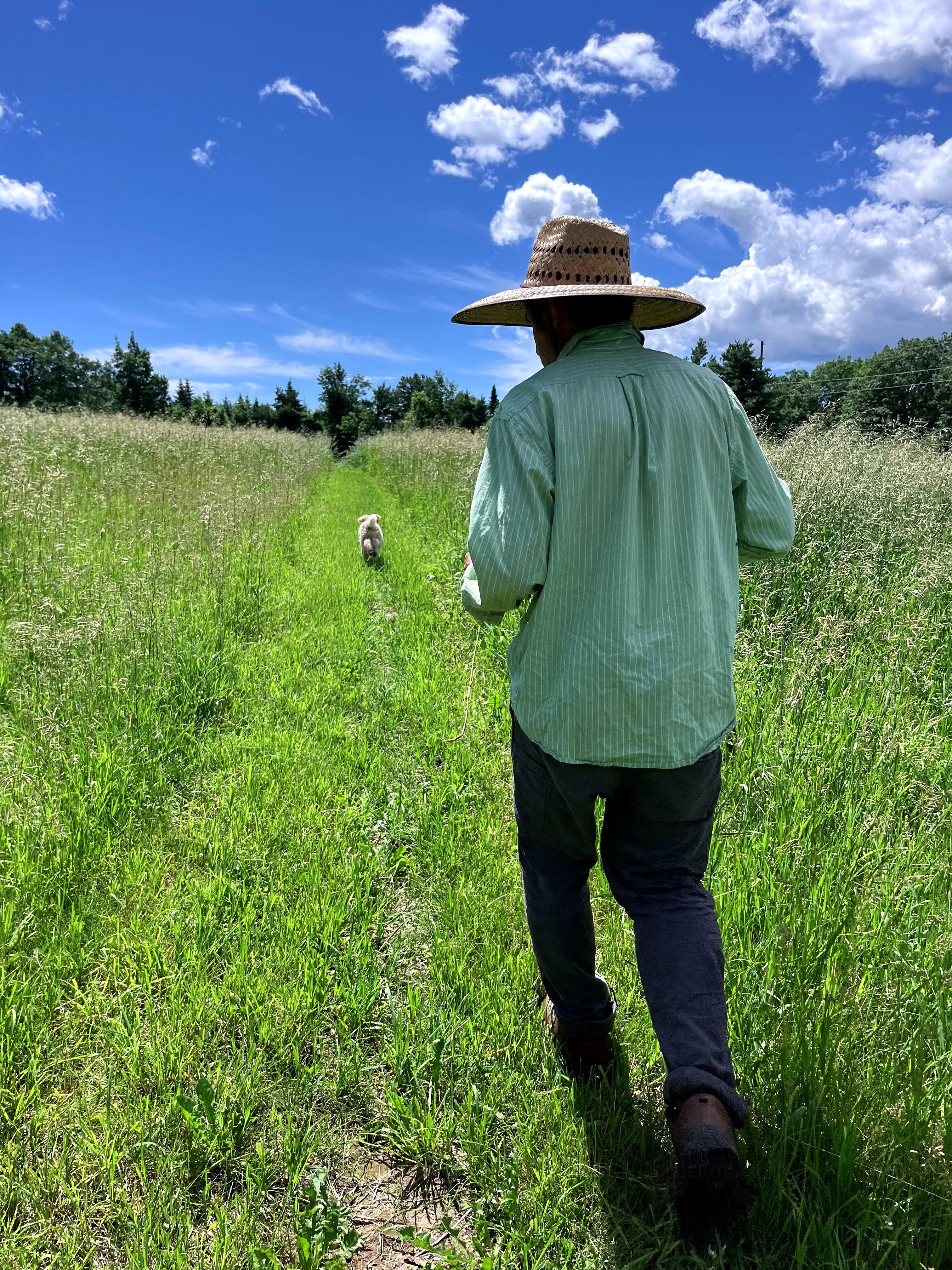
Darkness has fallen. The plaintive sound of cattle bawling from the field kept me up later than usual. The calves in the barn got them going—crying out for milk. Perhaps the fireflies’ arrival has quieted everyone down. Just the pulse of early summer crickets now. The puppy’s soft breathing from the corner. The tap-tap of fingertips on the keys of this glow-portal.
The final chapter of the book awaits a re-write. Once that final task is done, the whole thing’s off for final line edits—mostly grammar and citations. I’m going to miss this bugger, but also welcome the return of a nighttime sleep schedule.
The working title for the final chapter is A Letter to a Young Culture Worker: For the road home. It will come after the book’s proper conclusion, as a sort of afterword. As in, “if you are someone itching to put this stuff into practice, let me try to pack a few more stories into a satchel, for your safekeeping.” It feels particularly important to me. If you’re one of those people out there and you’re reading this, please know that you are always on my mind.
I have, on occasion, met the parents of someone who credits this newsletter as one of the reasons they quit their job or closed down their business and started offering their life’s labors as a gift instead. Those parents, in full knowledge of my involvement, have been remarkably graceful with me. Bless them for their courage. Here’s one of the stories that’s going into that satchel for the road home.
A Danish man named Peter went to live with the Greenland Inuit for a time. From them he learned to hunt walrus as they did. But there were other things to teach him as well. One day Peter returned emptyhanded from an unsuccessful hunting trip. An Inuit man, seeing this, dropped by with a large amount of fresh meat from his catch. Filled with gratitude, Peter thanked the man profusely. To his surprise, the Inuit man became agitated, saying:
Up here in our country we are human! And since we are human we help each other. We don’t like to say thanks for that. What I get today you may get tomorrow. Up here we say that by gifts one makes slaves and by whips one makes dogs.
By gifts one makes slaves, eh? It’s potent language, and probably not what any of us was expecting. I read this story for the first time several years ago, in David Graeber’s book Debt: The First 5,000 Years.1 To be honest, there was a part of me that wanted to pretend I hadn’t. It felt almost too hot to touch. When you love the word “gift” as much as I do, the connection between gift-giving and slave-making is troubling. I needed some time to let it cool down.
You could imagine a spectrum of human experience based on proximity or distance from source. In this story, a man raised within civilization—a word that essentially means “source distancing”—comes into close contact with someone living in a more proximal manner. It doesn’t make the Inuit man any better or worse than him, but it might make it easier for him to remember that human life comes from a real somewhere. If you asked the Inuit hunter “from where does your life arise?” he might point to the sea. When Peter thanked him for his generosity, he became irate. Why? Here’s what I’ve come up with.
From within a culture of normative sharing, thanking someone for their generosity might sound like an assumption that they might have considered proceeding otherwise, which could be heard as a sort of character assassination. The fact that it is hard to wrap our imaginations around that hearing of the ubiquitous phrase ‘thank you’ might have a lot to teach us.
From within a society of normalized non-sharing, the language of gift offers a tool for softening the ‘mine-or-yours-ness’ of the world around and within us. But it still gives the impression that our gratitude should flow from receiver to giver. At a distance from the source, there is a real danger that it doesn’t keep flowing, that it pools right there. And we’ve all seen what can happen to stagnant water. From within the world we’ve made, gratitude pooling is not only a danger, it is almost inevitable. Think about institutional charity. I might ask who the generous party actually is, the wealthy person who hands over the token gift, or the receiver whose face, name and story provide a short-term hit of guilt relief. This may be what the Inuit hunter was trying to teach there on the shore of that vast and generous ocean.
I have a sense that the medicine carried in the word gift will be essential for a couple of generations, after which time it will become less valuable, even offensive. It is medicine for here and now, not forever and everywhere. Like all medicine, it must be administered carefully.
So, in this final chapter of the book, I am attempting to offer a fledgling gift practitioner—what I’m calling a culture worker—some tools for navigating the near-inevitability that people raised in a society where philanthropists are considered generous will have a hard time seeing them as “windows to source.” Here at the Farm, at a distance from the sea, sunlight falls not on ocean water but on the leaves of perennial grasses and corn plants. Rather than a hunk of walrus meat, I might drop a quart of frozen beef and corn chili at your feet. I haven’t yet yelled at someone for thanking me, but perhaps that’s coming.
With love,
Adam
Originally from Peter Freuchen’s Book of the Eskimos.
At the risk of excessive navel-gazing, your post raises things in my memory. I’m thinking of a college friend, Tania, an Egyptian Jew who ran away to NYC from home in Paris at 14 bc she was a supporter of Palestinian rights, not popular in her family of refugees/survivors of the Jewish expulsion from Egypt. A natural-born Anthropologist, a “tumbleweed” as she put it, with roots everywhere and nowhere, who studied human cultures and could ‘feel with’ the best of each of them.
She taught me about gifting. I came from a long line of rooted (I should say transplanted) New Englanders, proud, self-sufficient, unconscious of our expropriative past or our Anglo culture that displaced a native culture much closer to the interdependent model Adam’s friend’s story describes. Tania was an enigma to me…she rarely came into my room at college without a gift in her hands, a pastry she had made, a bit of colorful handwoven ribbon that holds on a keffiyeh, that she brought back from travelling in Israel/Palestine. I felt uncomfortable and a bit overwhelmed by her constant, casual generosity. We talked about our cultural differences: my New England sense of not wanting obligation, her Semitic sense of making visible good will and relationship by way of exchange, which I tried to convince her was totally unnecessary, as I loved her for her intense curiosity and sharp intellect, and her wonderful laugh that burbled like a Winter Wren. Tania’s love of exchange extended to flea markets and tag sales, where she would always barter, to negotiate a mutually acceptable price, which I found totally embarrassing. But it was her native landless home-place, her culture, and she argued that marketers love the game, the interaction. I dunno, maybe I was missing something?
While I am still uncomfortable with personal gifts, (I’m trying to get over it), I love the “cult of gratitude,” mostly toward the natural world, and making the effort to bring my excess produce to the local food cupboard, and sharing wood from the family land on which I’m squatting with my neighbors, and the casual opportunity to pass on what I no longer can use to a friend in need (my perfectly lovingly-maintained chainsaw, for example, which I can no longer start.)
I fear our well-meaning super egos may tend to over think and make judgments about cultural norms different from our own, that exist in an entirely different historical context. If the word “gift” becomes as fraught to us as the word “free,” if we get too precious about our use of language to describe the non or less-transactional community we’re seeking, I fear we may become exclusionary or holier than thou. And how can we eschew gratitude, when Henry Schermerhorn kept that land intact for the Sand River farm community to do what they do? I am grateful for that, for your collective inspiration, and I am unabashedly much obliged to all of you. Sorry, I just am.
I’d say the Inuit man didn’t want to be seen or labeled as a Giver — didn’t want all the fuss around what he understood as a basic and unexceptional act. After all, people in reciprocal networks don’t thank each other for existing in their roles and simply doing what others need and do themselves in their own ways.
A gift requires a giver, who has the uncomfortable status of benefactor, and a receiver, who by definition is a beneficiary — a discrimination immediately arises. Why not see “giving” and “receiving” as equally necessary to the normal flow of life, part of an infinite web in a way that doesn’t give special status to either party?
And seeing oneself as a Giver demonstrates hubris, doesn’t it? This may be the most essential part of the story you’re telling here. But in fact, a “giver” should thank a “receiver”, not the other way around, if thanks are in order.
The whole cult of gratitude has been making me nervous for a long time. The cultivation of gratitude especially. I think joyous participation in the abundance of life aligns better with the whole shebang. Giving and receiving simply serve to connect people with each other as fellow beings. A hug expresses that better than the overused phrase “thank you”, which leaves the distance undissolved.