
The Book Sprouted Legs

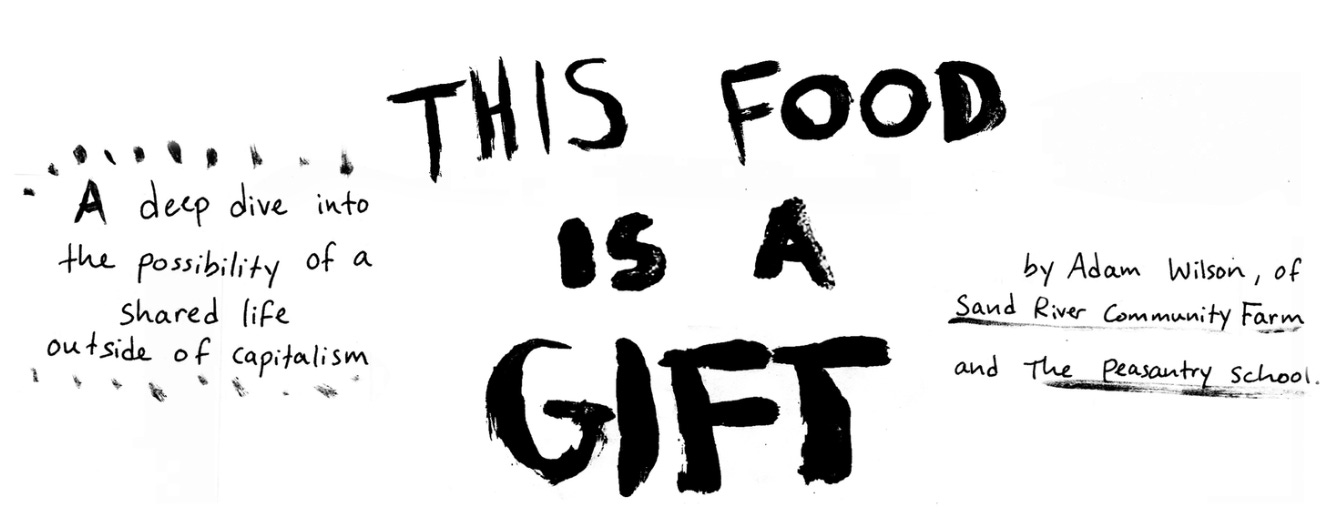
Greetings Neighbors and Strangers,
Take a walk with me for a few minutes, if you will. I point to a string of red blazes sprayed onto the furled bark of green-leafed ancients. On the ground below those blazes lies an invisible line. The line is real insofar as the act of its drawing unleashed immense consequence upon the inhabitants so circumscribed, and those who purchased their felled, milled, milked, mowed, dried, and baled bodies. But the line is also imaginary insofar as it shapes and informs the human imagination. Contorts is another word we could choose. Constrains, curtails, even curdles.
If there’s one thing I learned last week during a stretch of five speaking events in five days: words are miraculous creatures. Parcel, property, price tag. House and home. Neighbor and stranger. It’s mine. I earned it. The normalization of non-sharing. Words live by employing the tongues of the miraculous creatures we call human beings. Perhaps something similar could be said for those green-leafed ancients and their many-species neighbors: they live by employing the human heart.
I can’t wait to share the book I’ve written with you. It tells a story about drawing an imaginary line around a small patch of land. Nothing from that place would be for sale. All would be shared as a gift with anyone who was hungry for any reason. There wasn’t a plan back then. There still isn’t now. Relationships are emergent, surprising, and often quite contrary to one’s personal preferences. How will the electric bill get paid? Maybe we could we figure that out together, in conversation.
Early on, a thought came: if the plants and animals I lived and worked alongside and then ate for supper weren’t for sale, maybe I wasn’t either. What would that mean for my relationships, for my capacity to make requests—for my capacity to make home? Eight years in, it does appear that not being allowed to pay for the gift of Life begets a process of relational tethering—to people and to place. Tethers have a way of tugging on the human heart.
Gratitude doesn’t live in the future. You simply won’t find any there. Gratitude lives in the human capacity for memory. But not all memories are comfortable or affirming. Some memories feel like they might swallow us whole, especially if we turn around and face them alone. As a European American man, I can vouch for this fear. But how did we get to the point of thinking that we were supposed to do any of this alone?
Of the many potent questions people asked during those five story circles last week, one seems particularly instructive this morning: “Why do I feel guilty when I receive a gift?” The question, carried on a string of ten words, is a small miracle. Even, dare I say, a creature. It inquires into the broken heart of something that is absolutely not personal. Look, over there, the question is scurrying off, into the underbrush of our shared life. Shall we follow it together?
This Food is a Gift
Over the past month, the book project has sprouted legs and begun scurrying about. Suddenly, timelines have been scrawled onto digital whiteboards. Names have been assigned to different categories of tending. Tender new relationships have been forged.
Over the coming weeks, I will introduce you to the remarkable folks who have formed a team around the book project: Meg Mittelstedt, Myles Lamont, Charles Day, Eleanor Robins, David Drury, Sam Bliss and Kelsey Rosenblum. Together, we’ve taken up the very practices the book lays out as we engage the shared labor of moving a manuscript from its Google Doc womb onto real paper and then out into the bright light of a hurting world. I couldn’t be more thrilled to be laboring alongside such remarkable human creatures, and I will do everything I can to set the conditions for the following outcome:
1. Each person on the team gets to feel, at least once a week, like the luckiest person alive.
2. Each person feels worthy of asking to be sustained.
3. Those requests for sustenance are clearly articulated on the book’s website.
4. Money begins moving as a result of human gratitude rather than price tags.
That’s right, the book has a website, which is now live: www.thisbookisagift.org.
One of the most relieving things about working with a publishing team is that I don’t have to make all of the decisions. When Charles drafted the website, he decided to include the book’s preface. Myles and Meg thought that was a good decision. So, the first three pages of the book are now available at www.thisbookisagift.org. I’ll leave you with a little taste. More on the team and their requests next week.
Preface: This Book is a Gift—Falling Back into Practice
You hear a knock at your door. Hello, it’s me, a stranger, holding a quart of the beef and corn chili we just made here at Sand River Community Farm, a patch of Earth where nothing is for sale. I introduce myself and ask, “Would you be willing to receive this gift of food?” Again and again, I hear people say: “But surely someone needs this more than I do.” Can you imagine how different the world would be if everyone wrestled with that thought as they wandered the aisles of the grocery store, or any store for that matter?
For the past eight years, I have worked with my neighbors to grow and offer food as a gift to anyone who is hungry for any reason. It has become abundantly clear to me that modern people are a lot more comfortable giving than receiving, which points us toward the central assertion of this book: the transactional norms of the marketplace have left our gratitude muscles badly atrophied.
The gratitude I am describing is less a spoken laundry list of the things that worked out for us today than an awareness of our deep-running relational obligations to people and place. Belonging isn’t something we find or feel. It is something we do.
If this book is to serve as a practical guide to agricultural gift economics, we’ll have to get clear on what we mean by the word practical. The Greek root praxis means exercise, or action. It means doing something, not just talking about it. The type of gratitude I am talking about moves us from noun to verb, from emotion to motion. It turns warm fuzzy feelings into cultural organizing principles.
To read the rest, you can find your way over to www.thisbookisagift.org.
With excitement,
Adam
Adam!!!! This is so exciting!!! So much movement!!! And a team at last. Wonderful. I am so delighted to read this. Xxx
This is so beautiful, Adam. We’re all enriched.