
What about the billionaires?
Turning a toad into a roast chicken.

Greetings Neighbors and Strangers,
I have been noticing a pattern of speech that has begun to trouble me greatly. It goes something like this: “There are all of us normal people and then there are the billionaires.” The suggestion is that they have crossed over a threshold of no return. That they are the bad ones. I am afraid that such idle conversation may be very dangerous.
Two days of gentle rain fell on dusty ground last week, waking an army of slumbering midsummer minstrels. They’ve come, it seems, to wage war on the human capacity to forget that Life is a song sung to us by the past. I don’t actually know if it is possible to love crickets any more than I do. And I was worried that they weren’t going to play for us this year. Given the heat waves, the droughts, and the fires, that seemed a real possibility. But here we are again, on the receiving end of an auditory grace that pours in through open windows, saturates the night house. Penetrates the soft skin on the inside of these ears. Pushes its way out through the tips of these typing fingers. If you’re listening to the recording, you might be able to hear these foot soldiers of the midsummer meadow. Having their way with a human heart. I blame this newsletter on them entirely.
The word greedy means hungry; it describes an insatiable appetite, a relentless craving. The ‘pet’ root in the middle of the word appetite can be found also in petition, petulant and compete. The Latin root petere suggests “to seek, ask, or lay claim to.” The word crave, from the Old English crafian, carries a similar spectrum of procurement tactics: “to yearn, beg for, or demand.” The trail of breadcrumbs that begins with greed appears to point us in the following direction:
There has always been human desire, and there has always been the question of what we do with it—what we do in its presence. Perhaps the possibility of our shared life has always hung in the balance.
Some of my teachers never fancied themselves as such. One early conversation partner offered me regular, and quite vulnerable, reflections on the food-gifting work that I’d found my way into. If you’ve been reading these newsletters for any amount of time, you’ll likely have a sense that sharing food as a gift can open a door to “a hundred acres of thought long banished from the West,” to use a fetching phrase from Martin Shaw.
This person had been on the receiving end of a higher-than-average flow rate of family money, and so the questions the Farm was asking about scarcity and abundance, stinginess and generosity, entitlement and gratitude, and the sanctity of private property, weren’t entirely welcome. The property this person’s parents had purchased for her was worth well over a million dollars, with quite a few buildings to maintain. Owning things can begin to feel like a lot of work.
At some point this person reached a breaking point with the questions I was asking, and decided to cut me out. In our final conversation, this person told me that she was grateful that the world had put us together, that she’d actually learned a lot from the relationship. She had been forced to wrestle with unworthiness and guilt along the way, but, ultimately, she’d realized something that felt important to say out loud. With a slight tremble in her voice, this person said: “At the end of the day, this is my property. I earned it.” I stood facing her in stunned silence for a long moment. Then she said, “Well, if I didn’t earn it nobody else did.”
It’s still one of the most revealing lines anyone has ever said to me. If nobody earned it and it ended up with my name on it, what shall I do now? The question applies equally to an acre of land, a dollar bill or a loaf of bread.
The trail of breadcrumbs beginning at the word earn leads us back to Proto-Indo-European grain fields at harvest time. The word earn suggests that you’ll have something to eat this winter if you diligently prepare the ground, plant the seeds and control the weeds. The word earn focuses our attention on human labor as the wellspring of human life. Going steady with a single domesticated grass has real risks, it seems. We might wake up one day and notice that we’ve grown a bit possessive. As in, “I harvested it, or purchased it; now it’s mine.”
I read a study once that attempted to determine which category of Americans has the smallest ecological footprint. By some complex figuring, they determined that Buddhist monks came in second and homeless people led the way in low-impact living. But then they discovered something quite surprising, and unsettling. A street person in American has an ecological footprint eight times larger than the average citizen of Bangladesh. I know, data can be sliced and diced to fit anyone’s agenda. However problematic the analysis may be, it does invite me to ask the following questions:
In whose story am I the billionaire? In whose eyes do I look like a bundle of endless craving?
Christian missionaries often took aim at old practices of venerating the dead; what some call ancestor worship. In The Huron Relations for 1635 and 1636, Jesuit father Jean de Brebeuf describes with awe-struck horror the elaborate annual ceremony during which the Huron exhumed the partially-decomposed bodies of those who had died over the previous year and brought them to a central pit for re-dressing and re-burial. Going to heaven would mean leaving the dead to fend for themselves. That was the choice on offer by the imperial Roman Christianity that arrived on their shores.
But Brebeuf couldn’t help admitting that the Hurons displayed some remarkable qualities. For one, they seemed to endure hunger much better than Europeans. After two or three days without food, you might “see them still paddling, carrying loads, singing, laughing, joking with each other, as though they had recently dined well.” Brebeuf goes further: “Their hospitality to any and all strangers is noteworthy. In their feasts, they give the best of what they have prepared to the stranger, and, as I have already said, I do not know whether anything equal to this can be found elsewhere.” By elsewhere, he is referring to the European civilization with which he is familiar. Brebeuf was trying to make sense of what he was seeing on the ground: the Huron appeared to be living out the Jesus example without ever having heard of the guy.
The First Nations Version of the New Testament uses the evocative name Creator Sets Free for Jesus. In the Gospel of Luke, a young man asked him how he could find an honorable life path.
Creator Sets Free told him, “Take all of your possessions and give them to the ones who have none.”
But the young man’s heart “fell to the ground,” for he had many possessions.
A great sadness came to the face of Creator Sets Free as he looked at the man. And then he said, “Walking the good road is a hard thing for the ones who have many possessions. It would be easier for a moose to squeeze through the eye of a beading needle.”
How would someone who hadn’t yet heard of Jesus figure out how to lead a generous life? I find one clue in an old oral story excavated by the Brothers Grimm, to which they attached the evocative title The Ungrateful Son. I encountered this story for the first time in Lewis Hyde’s book The Gift. Last week my editorial co-conspirators David and Sam joined me for one final read-through of the book manuscript before it heads of to the printers. We settled on the book’s title and subtitle: This Food is a Gift: Stories From a Farm Where Nothing is for Sale. When we reached The Ungrateful Son in chapter 5, we decided to cut it. “It’s almost too good,” one of them said. They call this killing off your darlings. Which freed it up to find its way into this newsletter. Here it is:
The Ungrateful Son
Once a man and his wife were sitting outside the front door with a roast chicken before them which they were going to eat between them. Then the man saw his old father coming along and quickly took the chicken and hid it, for he begrudged him any of it. The old man came, had a drink, and went away.
Now the son was about to put the roast chicken back on the table, but when he reached for it, it had turned into a big toad that jumped in his face and stayed there and didn’t go away again.
And if anybody tried to take it away, it would give them a poisonous look, as if about to jump in their faces, so that no one dared touch it. And the ungrateful son had to feed the toad every day, otherwise it would eat part of his face. And thus he went ceaselessly hither and yon about in the world.
Oral tales can’t be carbon dated; they ride on the air from one human memory to another, exiting one body on a series of shaped out-breaths before entering another body by way of the soft skin on the inside of the ears. If the story is a good one, it makes its way to the heart and then informs the action of those human hands.
In the story of the ungrateful son, a chicken has landed in the hands of a man who has, among others, a wife and a father to consider. The man seems to have decided that the cooked chicken makes two decent servings. Hunger is the assumed driving force in the plotline. The drama begins when the man’s father walks up, unexpected.
We have always lived in the presence of desire, the story suggest, and we have always lived alongside the responsibility to decide how we will respond to its unruly demands.
In a flash, the son decides that dividing the chicken three ways doesn’t fit the size and shape of his hunger or the satisfaction plan he’s come up with. The story doesn’t tell us whether the father was actually hungry or not, simply that his approach created a decision point. As far as we know, the father never learns about the darn chicken; he may have walked away thinking, “How kind of my son to serve me a drink and visit for a while.”
This isn’t a story about a vengeful father; there isn’t a lick of punishment to be found in it. This is a tale about the psychic consequence that builds, like a snowball rolling down hill, in the wake of each turn toward self-concern. We might imagine the son in the story thinking to himself, “I worked hard to raise the darn chicken. I planted and harvested the grain to feed it. I’m hungry. It’s mine.”
Once the father is safely out of sight, the son resumes his hunger-satiation plan. He finds instead a terrible toad that must be fed to keep it from eating him alive. Insert “consumer economy” or “civilization” for “toad” here if you’d like. Some of my ancestors lived in the landscape where this story once passed from tongue to ear, heart to hand. They may have seen this thing coming from a long way off. They may have been well acquainted with the ever-present seduction of ungratefulness.
Once a plate of food, or the land from which it has risen, has been transformed from a gift into a possession, and then into a commodity, an old oral story about ancestral goodwill may become more difficult to hear, and then more difficult to remember. The Brothers Grimm had to do some digging around to find whispers of these tales.
Ancestors can be hard to locate using the conventions of modern English. I know because I’ve been trying for some time now. We might point to them with phrases like “the humans who loved Life deeply enough to return it in good shape,” or “the people who receded back into the soil they tended while they were alive, the soil from which the chicken on my plate arose.” Ancestors can be hard to locate when your whole family line has moved so many times that no one knows where that well-cared-for soil actually is, or where all of that goodwill went to.
So, what about the billionaires? What harm could there be in deciding that they are unredeemable?
Limitless desire has a future-oriented, treadmill like-quality. If you think about it, the satisfaction of hunger is how we vote “yes” to tomorrow. Hunger is essential; it only becomes dangerous once it had been divorced from the well-cared-for soils that give rise to human life—the hum- root of humus, humility and human. I am afraid that focusing on the billionaires serves to keep us on the treadmill.
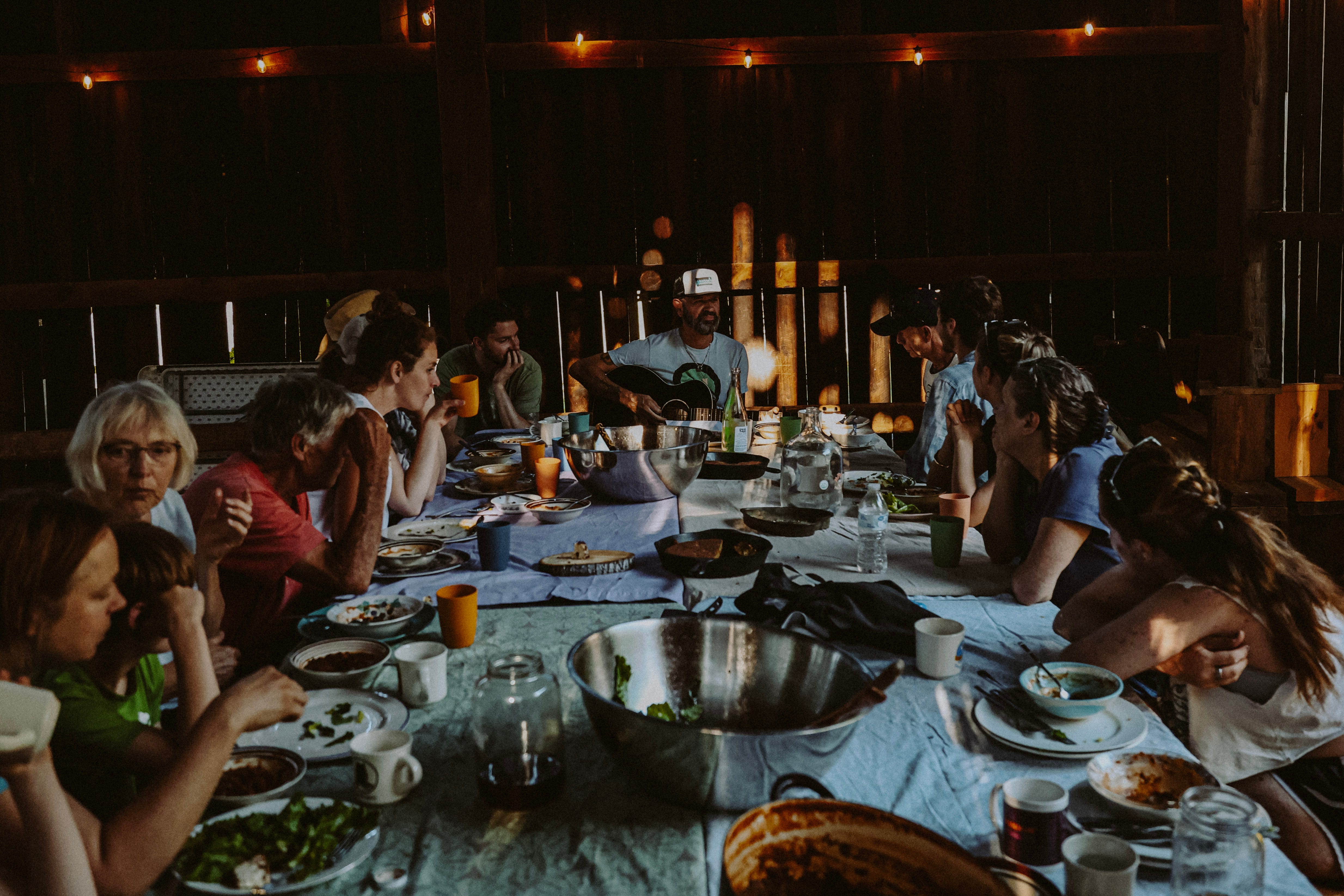
We could risk turning around and looking down, at the generous ground beneath our feet. We could risk losing the race. We could decide to set the table with everything we’ve got left and invite the whole neighborhood over for supper. The billionaires might wonder why it suddenly got so quiet behind them. They might get curious, even jealous. In a moment of gratitude FOMO, they might decide to stop and turn around. They might get to experience the ravenous toad transforming back into a roast chicken. We could give them that gift.
With love,
Adam
I am grateful to see that people have taken the time to weigh in. I know that I have a little billionaire inside of me, and that it isn't a personal failure, that the work of courting and befriending the inner billionaire leads us right back to the village square where we'll need to learn how to forgive and welcome back into relationship---self, other, ancestor, Earth. There is no victory story here.
When billionaires (the .01%) control 50% of the wealth you had better believe it’s a problem! If we don’t learn from history we will ALL pay dearly for it; from food to healthcare to housing to our very infrastructure. Famine, wars, climate crisis will be our legacy. We must start by radically changing the tax code back to more equitable levels; getting rid of citizens united and reestablishing the civil rights that have been so badly eroded under the most disgusting “president” in US history!